Measure and improve your agentic SDLC
Tuneloop analyzes every coding-agent session and links it to outcomes — so you can measure what’s working and tune your stack to ship more per dollar.
for platform teams reimagining the SDLC with AI
or run our open-source CLI — free, local, yourslearn more
Can you answer these?
- Are we shipping more features faster with AI?
- Which skills are most useful? Which need work?
- Is our team following coding-agent best practices?
- What share of complex PRs were fully autonomous?
- Will we see better outcomes per dollar with GLM 5.2?
- Are there areas where AI is leading to more reverts and hotfixes?
Engineering productivity metrics built for the AI era
Tokens and PR counts measure activity — trivially inflated in the AI era. Tuneloop measures outcomes.
Cost per Shipped Artifact
$31.03
per merged PR
What does a shipped result cost?
Time to Ship
12.3 days
median, ticket creation to resolved
How fast do features ship?
Code Churn Rate
18%
of lines rewritten within 30 days
How often does AI-written code get reworked?
AI Defect Rate
6.8%
of AI-assisted artifacts with a defect
Are AI changes causing more bugs?
Live numbers from running tuneloop on our own repos.
Measured automatically by linking agent sessions to your systems of record — not surveys, not token graphs, not vibes. You get spend attribution for every shipped feature, and session attribution for every line of code changed.
Benchmark agents and models on your own data
New models and agents land every other week, and you don’t have the cycles to keep up. Build SWE-bench-style benchmarks from your own repos and launch comparisons with one click — a leaderboard that reflects your environment, not someone else’s.
1,214 PRs mined407 passed filters168 created as tasks143 validated14 in this benchmark
Measure and optimize your whole agentic SDLC stack
You have agents, context files, skills, and MCP servers. Track health metrics for each in one dashboard, and get fix recommendations grounded in the errors and re-work from your team’s actual sessions.
Activation outcomes
changelog skill · 13 judged invocationsFollowed 62% (8)Reworked 23% (3)Bypassed 15% (2)
- Reworked
- The agent found no real v1.4.0 commits and wrote a placeholder stub following the skill’s format — the user then asked to improve the vague bullets.
- Bypassed
- The agent bypassed generating a v1.4.0 changelog entry and instead asked the user how to proceed, since no new commits existed.
The outcomes data layer that powers everything
Capture
Transcripts from every agent session — Claude Code, Codex, your own harness. They never leave your infra.
Link
Every session tied to the outcomes it produced — PRs, tickets, features, incidents — across your systems of record.
Improve
Benchmark datasets powered by that linkage, plus LLM enrichment that surfaces where to tune next.
every session makes the next one better
Run it for yourself, today
tuneloop is our open-source CLI — the single-player version of everything above. Point it at your Claude Code, Codex, or OpenCode sessions and get a local dashboard of what you actually shipped: outcome rate, cost per merged PR, and where your spend really went. Run LLM enrichment with an API key from your provider of choice, or a local model if you’d rather nothing leaves your machine.
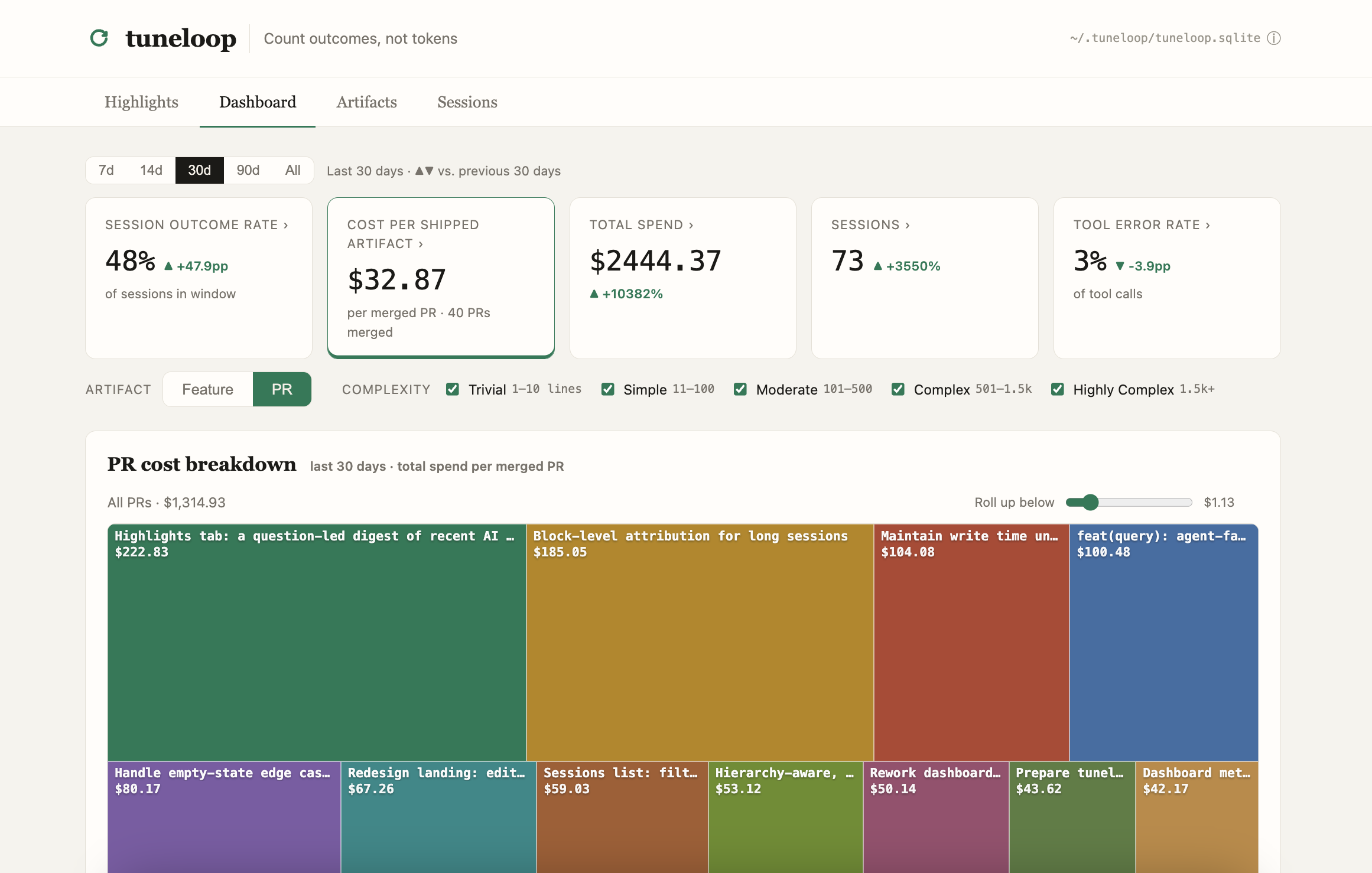
That’s tuneloop, single-player. The platform brings the same outcomes across every team — linked to your PRs, tickets, and incidents — and closes the improvement loop.
We’re building Tuneloop now, with a few engineering teams. If you’re wrestling with the questions above, we’d love to talk.